
Road Bike Frame Size Chart
Choosing a road bike size starts with your height and inseam. This pack gives you printable road bike frame size charts in centimetres and inches, a step-by-step inseam measuring guide, and worksheets for recording your fit and comparing frame geometry between models — so you can shortlist the right size before a test ride.
- Instant download
- Editable Word & Excel
- Print-ready PDF
- 7-day refund
5 files · PDF, DOCX, XLSX
Road Bike Size Chart & Fit Pack
Printable road bike frame size charts (height and inseam), an inseam and body measurement worksheet, a bike fit record, a test ride checklist and an Excel frame geometry comparison sheet.
- Size chart (PDF)
- Measurement worksheet (XLSX)
- Fit record (DOCX/PDF)
- + 2 more
$5.00 USD, one-time 5 files · about $1.00 each
- Instant download
- 7-day refund
- Secure checkout by Stripe
7-day money-back guarantee. Full refund within 7 days of purchase, even after you download.
Free sample: Road Bike Size Chart (PDF, 67 KB)
Road Bike Size Chart & Fit Pack
Printable road bike frame size charts (height and inseam), an inseam and body measurement worksheet, a bike fit record, a test ride checklist and an Excel frame geometry comparison sheet.
- Size chart (PDF)
- Measurement worksheet (XLSX)
- Fit record (DOCX/PDF)
- Geometry comparison (XLSX)
- Test ride checklist (PDF, DOCX)
Formats: PDF, DOCX, XLSX. Instant download after payment (link valid 72 hours, up to 5 downloads). AI-assisted: the templates were drafted with AI help and reviewed and laid out before publishing.
$5.00 USD, one-time 5 files · about $1.00 each
- Instant download
- 7-day refund
- Secure checkout by Stripe
7-day money-back guarantee. Full refund within 7 days of purchase, even after you download.
Free sample: Road Bike Size Chart (PDF, 67 KB)
Full refund within 7 days — see the refund policy and license.
Free printables
Single sheets you can print right now, no sign-up. The full pack adds every sheet in one download plus the editable files.
 Printable Road Bike Size Chart
 Printable Road Bike Frame Size Chart
 Printable Bike Fit Record
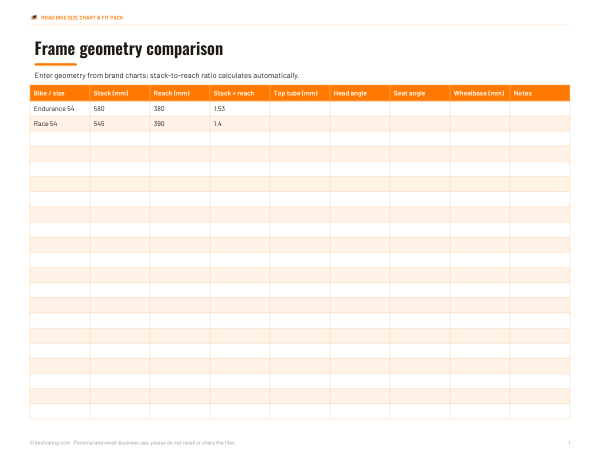 Printable Road Bike Geometry Chart
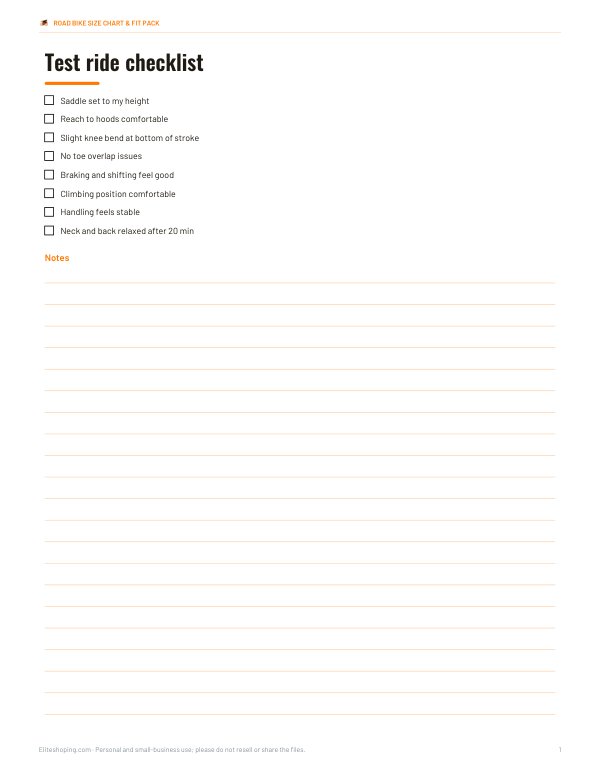 Printable Test Ride Checklist
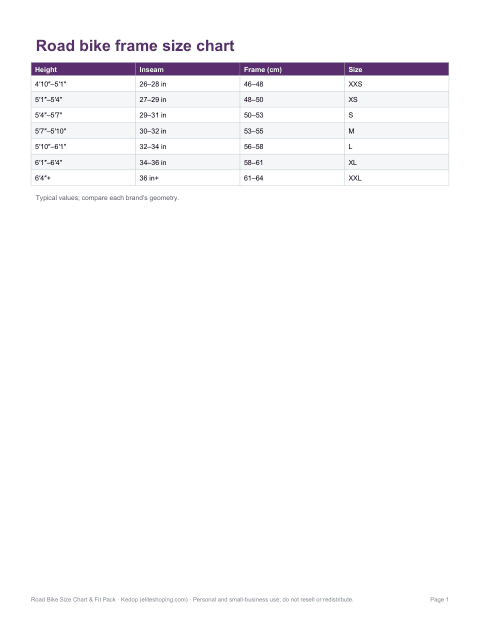
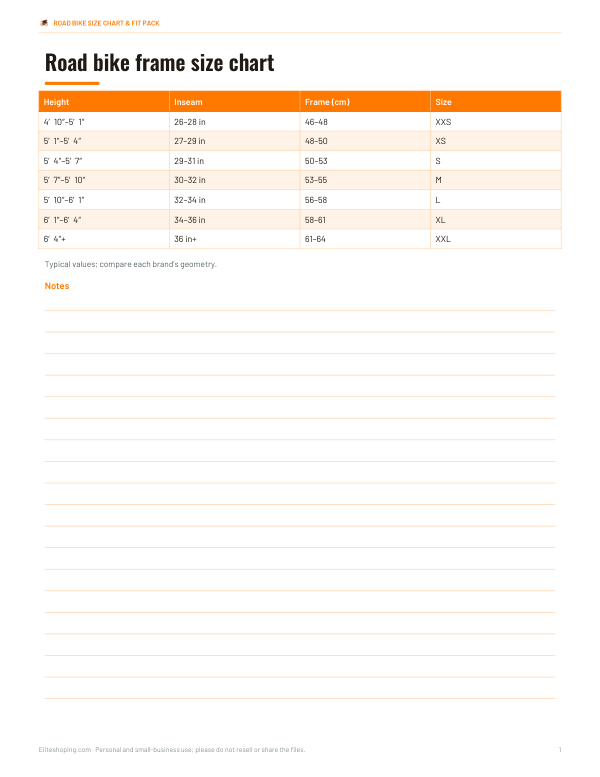
Road bike frame size chart
| Rider height | Inseam (approx.) | Frame size (cm) | Letter size |
|---|---|---|---|
| 4′10″–5′1″ (148–155 cm) | 26–28 in (66–71 cm) | 46–48 | XXS |
| 5′1″–5′4″ (155–162 cm) | 27–29 in (69–74 cm) | 48–50 | XS |
| 5′4″–5′7″ (162–170 cm) | 29–31 in (74–79 cm) | 50–53 | S |
| 5′7″–5′10″ (170–178 cm) | 30–32 in (76–81 cm) | 53–55 | M |
| 5′10″–6′1″ (178–185 cm) | 32–34 in (81–86 cm) | 56–58 | L |
| 6′1″–6′4″ (185–193 cm) | 34–36 in (86–91 cm) | 58–61 | XL |
| 6′4″+ (193 cm+) | 36 in+ (91 cm+) | 61–64 | XXL |
This is a typical guide. Frame sizes are measured differently by different brands — some along the seat tube, some as “virtual” sizes — so compare each brand’s own chart and geometry.
The inseam method
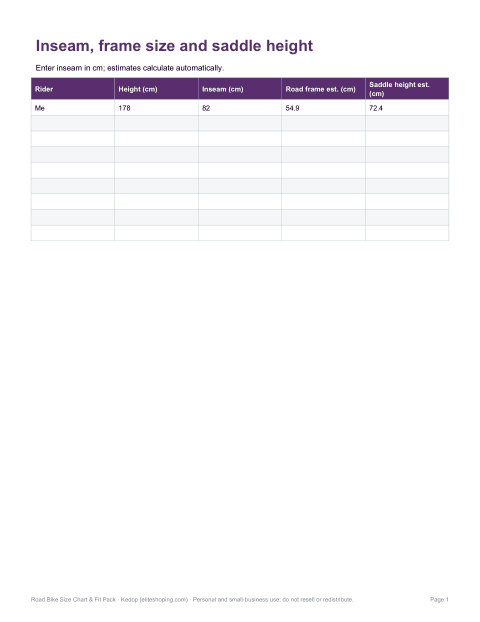
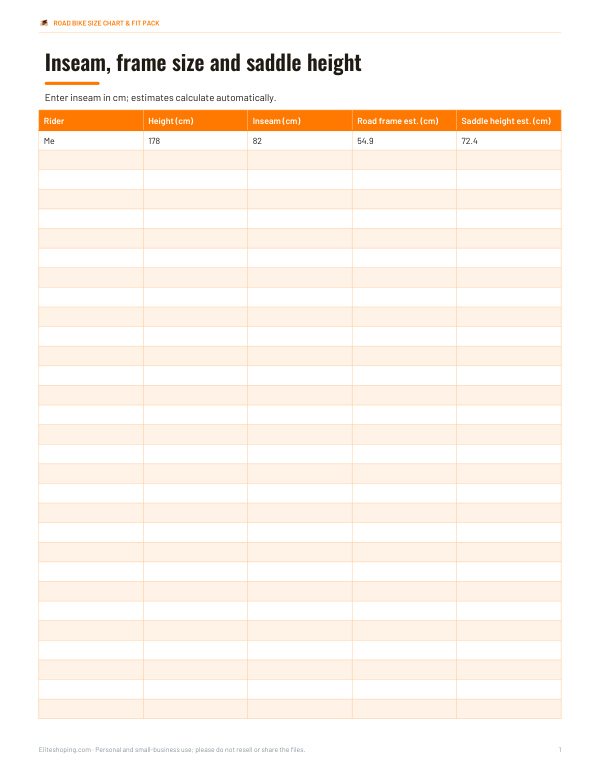
Inseam gives a better starting point than height because leg length varies between people of the same height. Multiply your inseam in centimetres by about 0.67 to estimate a road frame size: an 81 cm inseam suggests 81 × 0.67 ≈ 54 cm. The same inseam also sets your approximate saddle height, often estimated as inseam × 0.883 from the centre of the bottom bracket to the top of the saddle.
How to measure your inseam
- Stand barefoot with your back against a wall, feet about 15–20 cm apart.
- Place a hardback book between your legs, spine up, and pull it up firmly as a saddle would press.
- Keep the book level and mark the top of the spine on the wall.
- Measure from the floor to the mark in centimetres.
- Repeat two or three times and use the average.
Stack and reach
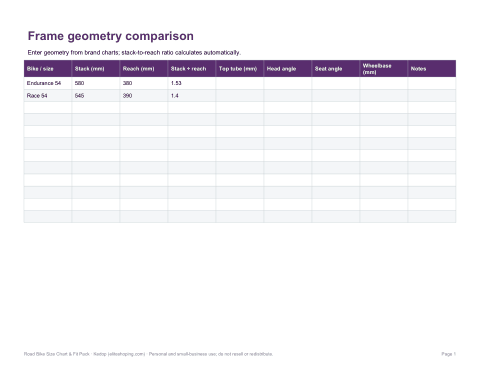
Modern bike fitting relies on two geometry numbers. Stack is the vertical distance from the bottom bracket to the top of the head tube; reach is the horizontal distance between the same points. Higher stack and shorter reach give a more upright, comfortable position (endurance bikes); lower stack and longer reach give a stretched, aerodynamic position (race bikes). Comparing stack and reach is the most reliable way to compare sizes between brands.
Endurance, race and gravel sizing
| Bike type | Fit character | Sizing note |
|---|---|---|
| Race | Low and long | If between sizes, flexible riders may choose smaller for a racier fit |
| Endurance | Taller stack, shorter reach | Comfort for long rides; good for most riders |
| Gravel / all-road | Similar to endurance, wider tyres | Often slightly shorter reach, longer wheelbase |
| Women-specific | Varies by brand | Compare stack and reach rather than labels |
What is in the pack
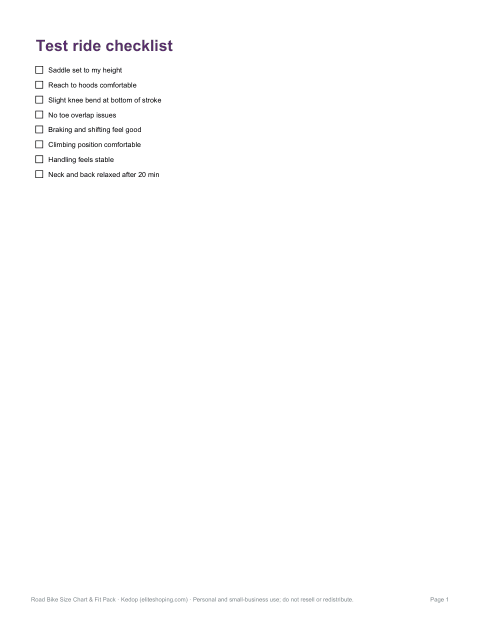
- Road bike size chart by height and inseam (cm and inches), print-ready.
- Inseam and body measurement worksheet with saddle height and frame size estimates.
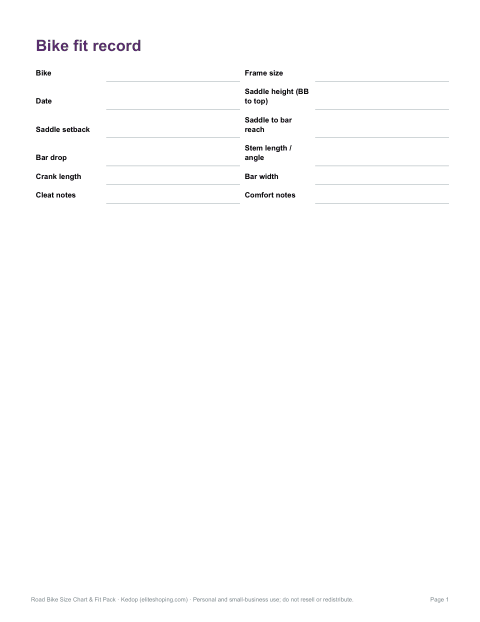
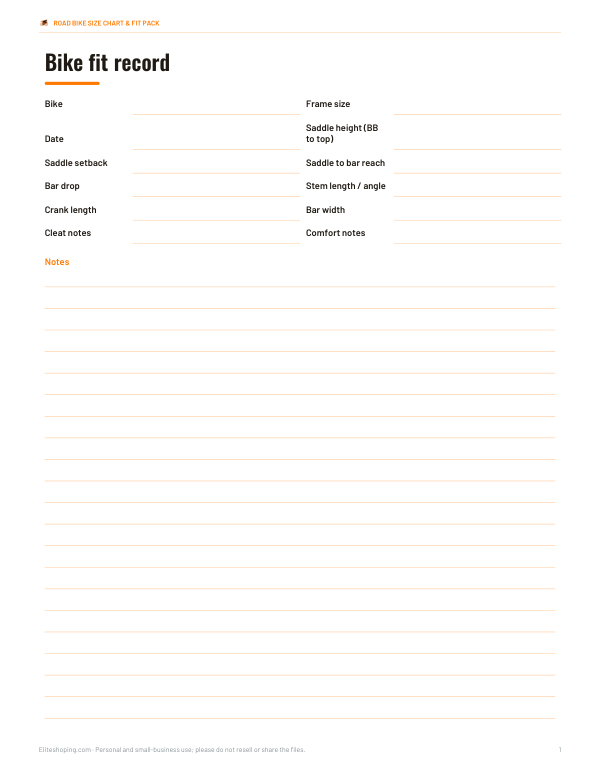
- Bike fit record for saddle height, setback, reach and bar drop.
- Excel geometry comparison sheet — enter stack, reach and other numbers for up to 10 bikes; stack-to-reach ratio calculated.
- Test ride checklist.
Test ride tips
- Ride at least 20 minutes if possible, including a hill.
- Check you can reach the brake hoods without locking your elbows.
- Look for a slight bend in the knee at the bottom of the pedal stroke.
- Hands, neck and lower back should feel relaxed.
- Small adjustments — stem length, saddle position — fine-tune the fit.
Formats
Print-ready PDF charts and worksheets (US Letter; A4 with “Fit to page”) and an Excel geometry comparison workbook.
Frequently asked questions
What size road bike for 5′10″?
Typically 54–56 cm, depending on inseam and brand geometry.
How do I calculate road bike size from inseam?
Multiply inseam in cm by about 0.67.
What is stack and reach?
The vertical and horizontal distances from the bottom bracket to the top of the head tube.
Should I size up or down between sizes?
Down for a racier, more manoeuvrable fit; up for a more upright, stable fit — test ride if possible.
Was AI used to create the charts?
The charts were generated by script and text drafted with AI assistance, then reviewed before publishing. Brand charts take priority.